
Ayurveda and the Seasons of Menopause - A dosha-inspired guide
Fern Carbonell | JUL 1, 2025
What are the Ayurvedic Doshas?
Let’s begin with a short explainer of what Ayurveda is. In Ayurveda, everything—your body, mind, even the seasons—can be understood through the lens of the three doshas: Vata, Pitta, and Kapha. These are energies made up of the five elements (earth, water, fire, air, and ether), and they shape how we feel, think, move, and age. Ayurveda helps me assess where my body may be out of balance and offers a path toward restoring harmony and well-being. There’s a quiz at the end to help you determine your dominant dosha.
- Vata is air and ether—light, dry, and mobile. It governs movement, the nervous system, and creativity.
- Pitta is fire and water—hot, sharp, and intense. It rules digestion, metabolism, and transformation.
- Kapha is earth and water—heavy, soft, and stable. It governs structure, immunity, and lubrication.
Each of us has all three, but in unique proportions that form our personal constitution, or prakriti. That’s why some of us run hot and fiery (Pitta), others are cool and dreamy (Vata), and some are steady and nurturing (Kapha). Your dominant dosha influences everything from your digestion to your mood—and it can also point the way to the most effective self-care.
Here’s the empowering part: when you know your dosha, you gain insight into how to care for yourself more wisely. You begin to understand your cravings, your energy dips, your emotional rhythms. And you can start to make small adjustments—what you eat, how you move, how you rest—that gently bring you back toward balance.
My dominant doshas are Pitta and Kapha. That means I naturally lean toward being structured and focused (thank you, Pitta), as well as grounded and nurturing (hello, Kapha). But when Pitta—the fiery one—gets out of balance, I have a tendency to push too hard and edge toward burnout. That kind of overdrive eventually pulls Kapha out of balance too, leaving me feeling heavy, melancholy, and craving sweets for comfort. Knowing my dosha makeup helps me stay more aware and make choices that support balance—because let’s be honest, balance isn’t always easy, but it’s worth paying attention to.
In a future post, I’ll share specific ways to balance each dosha. But for now, just noticing your patterns and learning about the doshas is the first step.
As we move through life, and especially during menopause, our doshas can fall out of balance. Maybe you feel more anxious than usual, or your digestion is off, or you're just foggy. That’s your inner system calling out for attention, and Ayurveda gives us tools to listen and respond with care.
Knowing your dosha is like having a personal wellness map. It helps you understand why certain foods, activities, or routines feel nourishing while others don’t. And during a transition like menopause, when things can feel unpredictable, having that map is especially grounding (the airy vata can dominate so we need to balance with earthy kapha).
So let’s explore how each stage of menopause aligns with the doshas—and how you can gently support yourself through the shifts.
The Doshas and the Stages of Menopause
Menopause isn’t a single moment in time—it’s a journey. And like any good journey, it changes us. Ayurveda, the ancient system of healing, offers a beautiful and insightful framework for understanding this transition through the three doshas: Vata, Pitta, and Kapha.
As explained earlier, each dosha is a combination of the five elements, earth, water, fire, air, and ether, and represents certain qualities in our body and mind. We all have a unique constitution, but as we age, the doshas influence shifts. Let’s explore how each stage of menopause relates to these elemental forces and what they can teach us about balance, compassion, and care.
Note that the age ranges listed below are generalizations and you might fall outside of those ranges, like I did.
Perimenopause: The Pitta Phase (Fire + Water)
Late 30s to mid-40s
This phase is governed by Pitta dosha, the energy of transformation. Pitta is sharp, intense, and fiery—think hot flashes, night sweats, irritability, and those emotional surges that feel like you’ve suddenly been set on simmer.
But it’s also a time of fierce clarity. This is when many women begin to reevaluate their lives, careers, and relationships. The fire of Pitta helps burn away what no longer serves. I ended relationships, cut my hair onto a pixie, quit my job, moved to Austin and went full time with my then side gig.
Supportive practices:
- Cooling breath work (like Sheetali or gentle Ocean Breath)
- Bitter, astringent, and sweet foods (think greens, berries, and root veggies)
- Meditation or journaling to process strong emotions
- Restorative yoga to temper the inner fire
Menopause: The Vata Phase (Air + Ether)
Mid-40s to mid-50s
When menstruation ceases, we enter the Vata phase—the dosha of movement and change. Vata is dry, light, airy, subtle, and mobile. It governs the nervous system and is linked to symptoms like insomnia, anxiety, vaginal dryness, and feeling mentally scattered or ungrounded.
Vata can also bring spiritual insight, creativity, and a deeper desire for solitude or silence. It’s a time to listen inward.
Supportive practices:
- Warm, moist, grounding meals (stews, soups, spiced teas)
- Regular routines and gentle movement like yin or restorative yoga
- Self-massage with warm oil to calm the nervous system
- Grounding rituals: nature walks, slow breathing, stillness
Postmenopause: The Kapha Phase (Earth + Water)
Mid-50s and beyond
After the fluctuations settle, we move into the Kapha phase—a time of steadiness, wisdom, and reflection. Kapha is slow, heavy, and stable. While this can bring deep inner peace, it may also manifest as weight gain, sluggish digestion, lack of motivation, or emotional heaviness.
But here’s the gift: Kapha offers us the sweetness of life. Connection. Intuition. Grace. The opportunity to root deeply and live with intention.
Supportive practices:
- Invigorating movement like sun salutations, walking or strength training
- Spices that spark digestion and metabolism (ginger, turmeric, black pepper)
- Laughter, play, and meaningful community
- Practices that spark joy and release stagnation
We Are Each Unique
While it’s helpful to explore the stages of menopause through the lens of doshas, we are each unique. You may experience a strong Vata imbalance in your 40s or Pitta symptoms well into your 60s. The key is not to box yourself in but to use Ayurveda as a gentle guide—an invitation to observe, nourish, and support yourself with loving awareness.
Menopause isn’t a problem to fix. It’s a time to practice tenderness and self-compassion towards yourself during this natural transformation. Ayurveda reminds us that balance is possible, no matter where we are in our journey.
Dosha Quiz
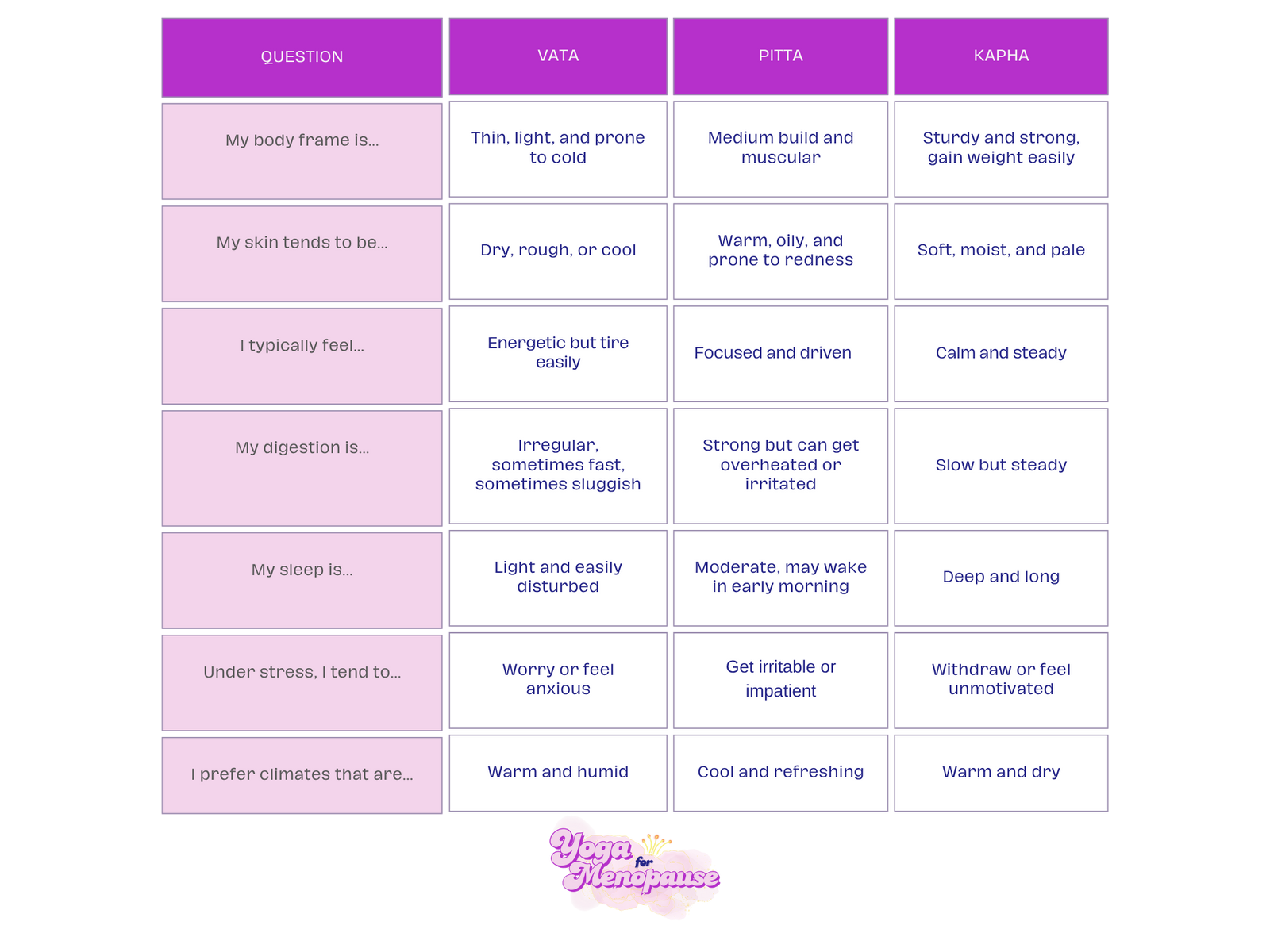
The quiz below is simple quiz and provides a general idea of your dominant dosha. The dosha with the most selections is your dominant dosha and it’s possible to have multiple doshas, like I have. If you want something more comprehensive, take the quiz on Banyan Botanicals. You’ll be asked for your email address to receive your results and recommendations. This is a quiz I take few times during the year when I need help identifying any imbalances I’m feeling.
Tally up the selections and the dosha with the highest number is your dominant dosha. It’s possible to have two or all three!
Dosha Balancing Checklist
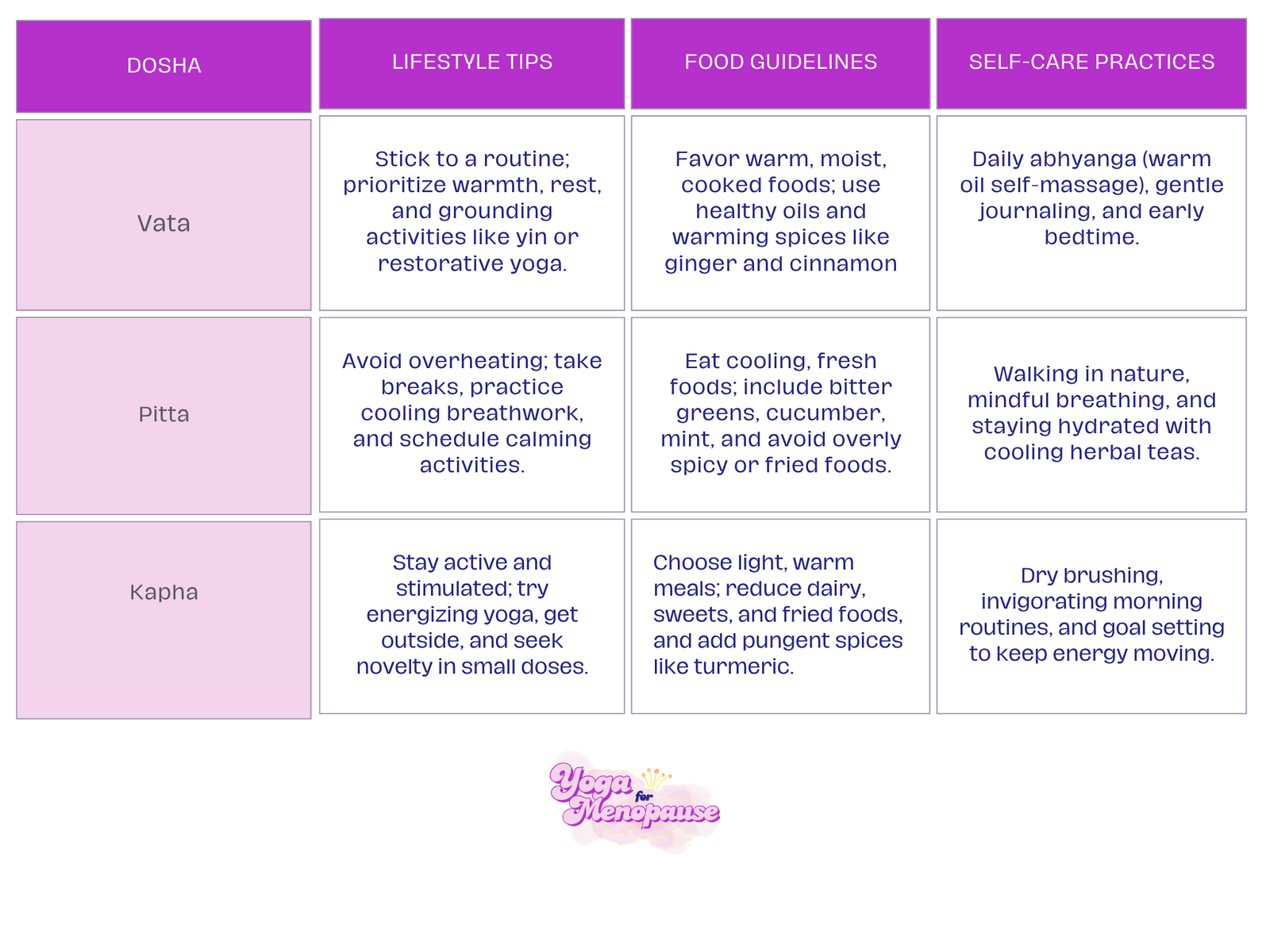
This checklist offers a helpful introduction if you’re just beginning to explore Ayurvedic principles. Use this as a guide based on your quiz results above.
Additional Resources:
- Perfect Health by Deepak Chopra - This is a great introduction to Ayurveda, the one I started with over 15 years ago.
- Balance Your Hormones, Balance Your Life by Dr. Claudia Welch - This is a guide specifically for women through the lens of Ayurveda and Traditional Chinese Medicine (TCM).
Fern Carbonell | JUL 1, 2025
Share this blog post

 OfferingTree